Natural stone retaining wall
Early summer in the Missouri Ozarks.
Use natural stone instead of concrete pavers for your patio or walkway.
Once a layer of stone is wedge up enough, a long pry-bar can finish the job.
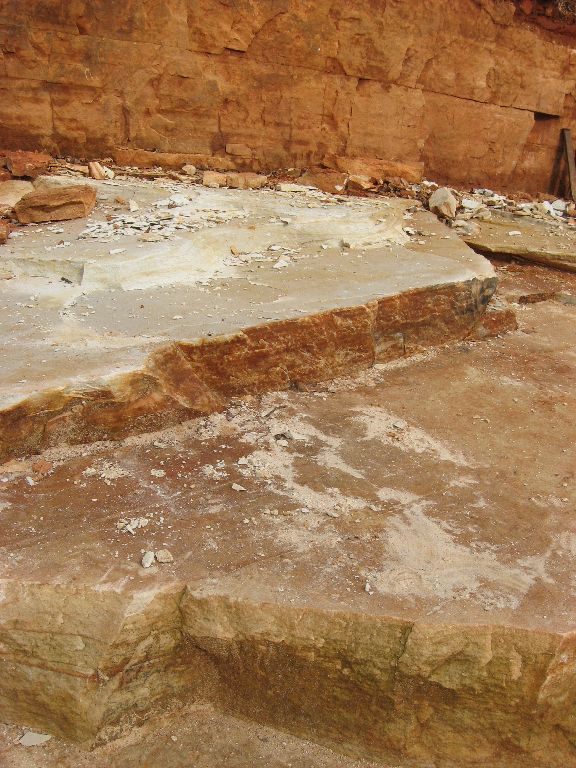
The first step in removing your sandstone uses hand-formed flat wedges. The wedges are pounded into the weakest seam between sandstone layers.
A flat wedge (a simple inclined plane) is one of the simplest and most powerful tools ever used by man.
Wedges can be pounded in horizontally in the natural seams within the rock or vertically along cracks that have formed over time from uplift and decay, freeze-thaw, or the extreme pressure exerted by tree roots.
The work is nearly done...let me just rest my back a bit...
Stones of all sizes (flags, steppers, and small filler) are used when stacking to ensure the promised square footage.
In extremely hard stone, feather wedges are pounded into drill holes until a crack is wide enough for flat wedges to be pounded in.
Wedging is best done in winter using a 12 pound sledge hammer and a reasonable amount of rest stops.
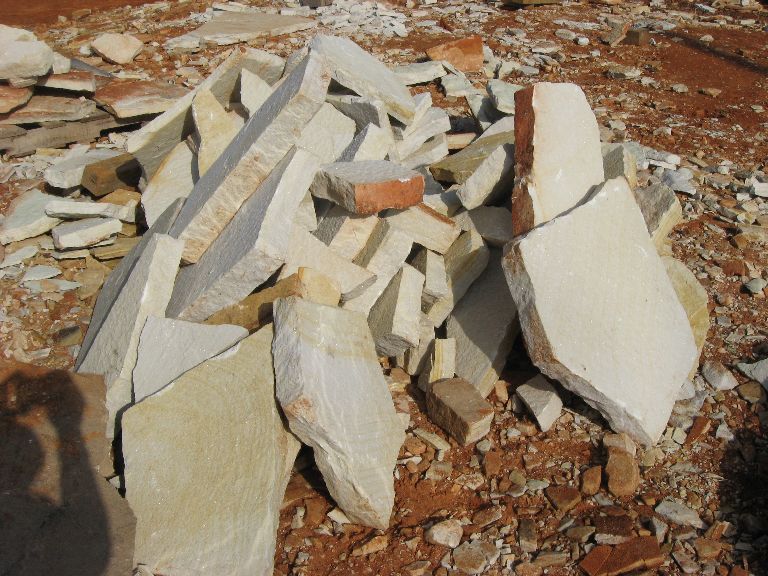
Stones are sorted by thickness and color. Here is a pile of 2-3inch lighter stone.
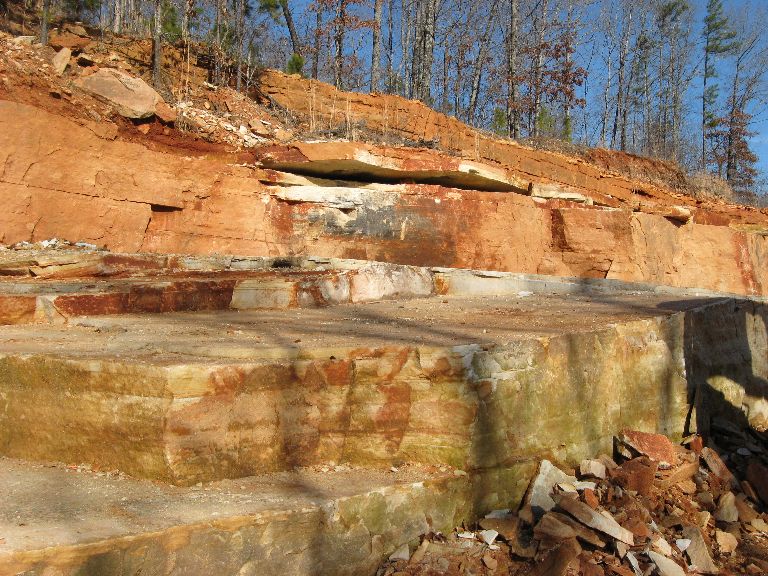
Our sandstone is removed in the same way that it was laid down...horizontally.
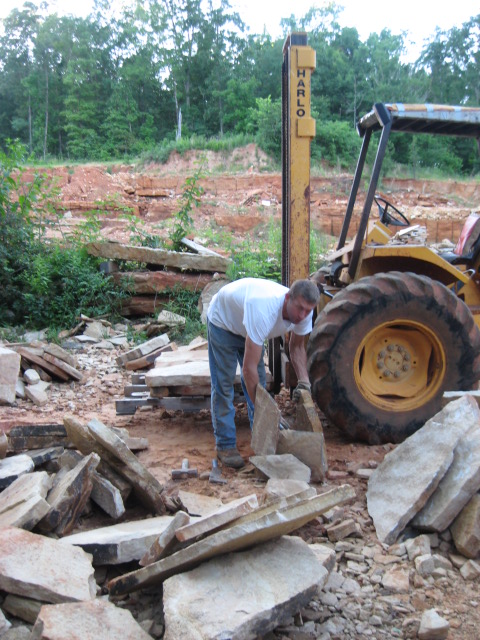
Once the stone is wedged up the forklift is used to take the stone to where it can be split.
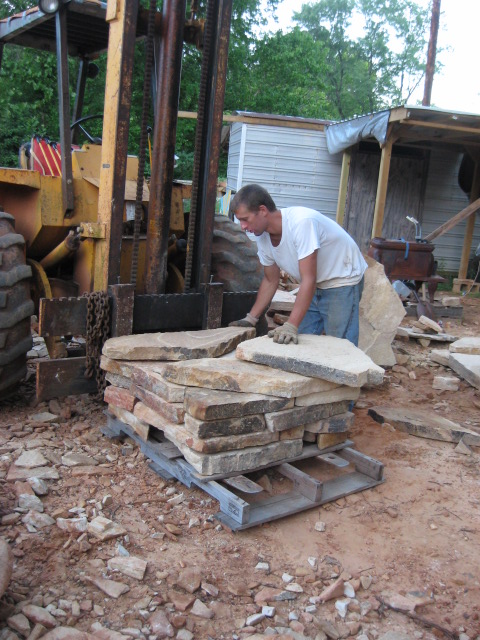
After sorting, stones are neatly stacked on a 10 square foot pallet.
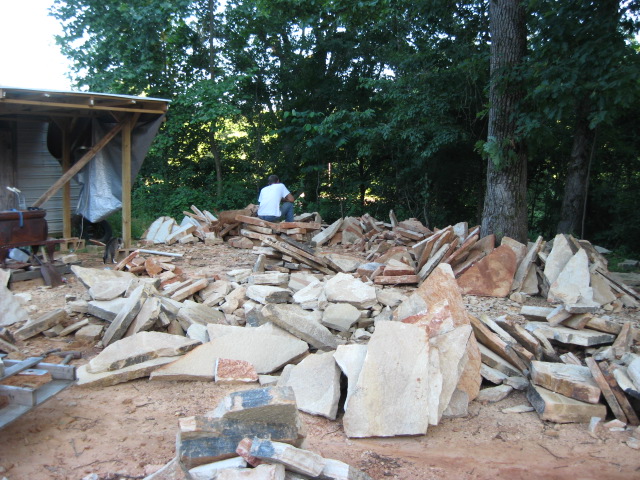
After splitting, cutting, and shaping, stones are ready to be stacked.
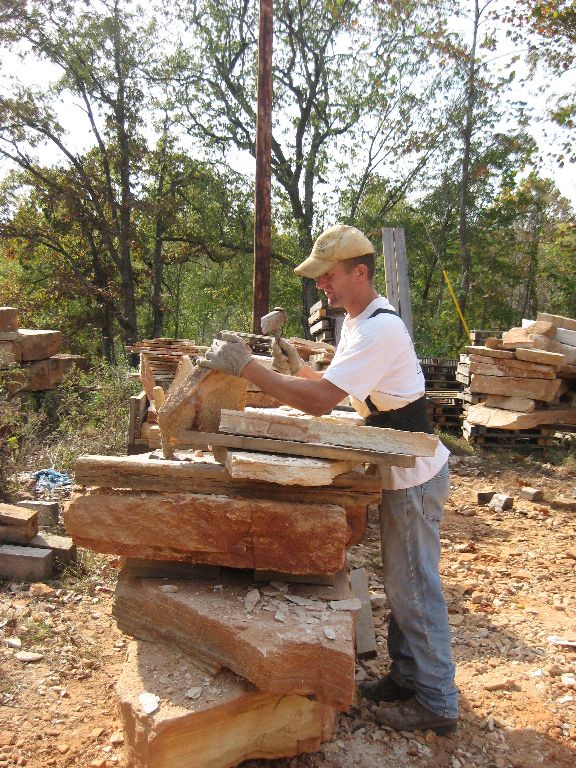
Each stone is cleaned and finished so that each face and edge is as neat as possible.
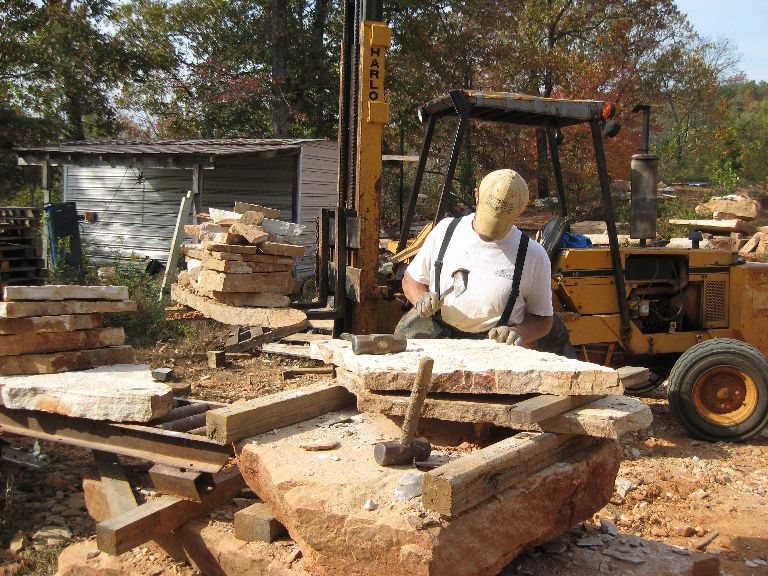
After splitting, stones are hand-cut down to a manageable size.
Splitting your sandstone takes patience and a good knowledge of the stone being worked. Usually a seam will have to be struck using a 12 pound sledge and a 4 pound splitter (wedge-headed hammer).
Sandstone is laid down horizontally in layers of varying thickness.
Each layer of stone changes laterally and vertically so that different colors and textures are revealed.
Sandstone was once a layer of sandy sediment (like on a sandy beach) that has been compressed over time into sedimentary rock.
Finn Gottschalk (left) and David Stockbauer (right) - Your stone was wedged, split, cut, and stacked by either Finn or David.
Smaller orders (up to 6 tons) can be loaded and delivered directly to you. In the spring, small orders are lumped together.
Pallets can usually be delivered very close to the job site.
A finished pallet is topped with a few extra stones and is ready for a customer.
Pallets of stone are unloaded using a rough-terrain pallet jack lowered by a heavy-duty winch.
Large orders up to 20 tons are sent out on a flatbed truck.
Anne Gottschalk (with Clay) - Anne works with you on your order answering questions, getting you the color, size, and quantity of stone you're looking for, and arranging pick-up or delivery for your stone.
Stone can be loaded on your truck or trailer. Most 1/2 ton trucks can fit one ton in their bed or pull 3 tons on a solid trailer.
Gottschalk Sandstone Quarry
Tour the Quarry
Louis the quarry dog